

Following the example of major French companies, RATP Smart Systems (RSS) has made the strategic choice to develop its own in-house generative AI platform: RAIL — RATP Smart Systems AI Lab. A look back at the genesis, features, and ambitions of a tool designed by and for RSS teams.
The Context: Why Build Your Own Platform?
In late 2022, the emergence of ChatGPT profoundly shook the professional world. As in many companies, RATP Smart Systems employees quickly perceived the potential of Large Language Models (LLMs) to accelerate their daily work. However, this enthusiastic adoption raised a major issue: data security and confidentiality.
Using consumer-grade generative AI tools with corporate data exposes the organization to the risk of data exfiltration and reuse by model providers. This observation is shared across the sector: Orange, for example, initially banned the professional use of public ChatGPT before launching its own secure internal tool, named Dinootoo, in September 2023.
At RSS, the response was similar and swift: create a controlled generative AI environment hosted on secure infrastructure, allowing employees to harness the power of LLMs without compromising company data. Since February 2022, RSS employees have had access to GenAI tools.
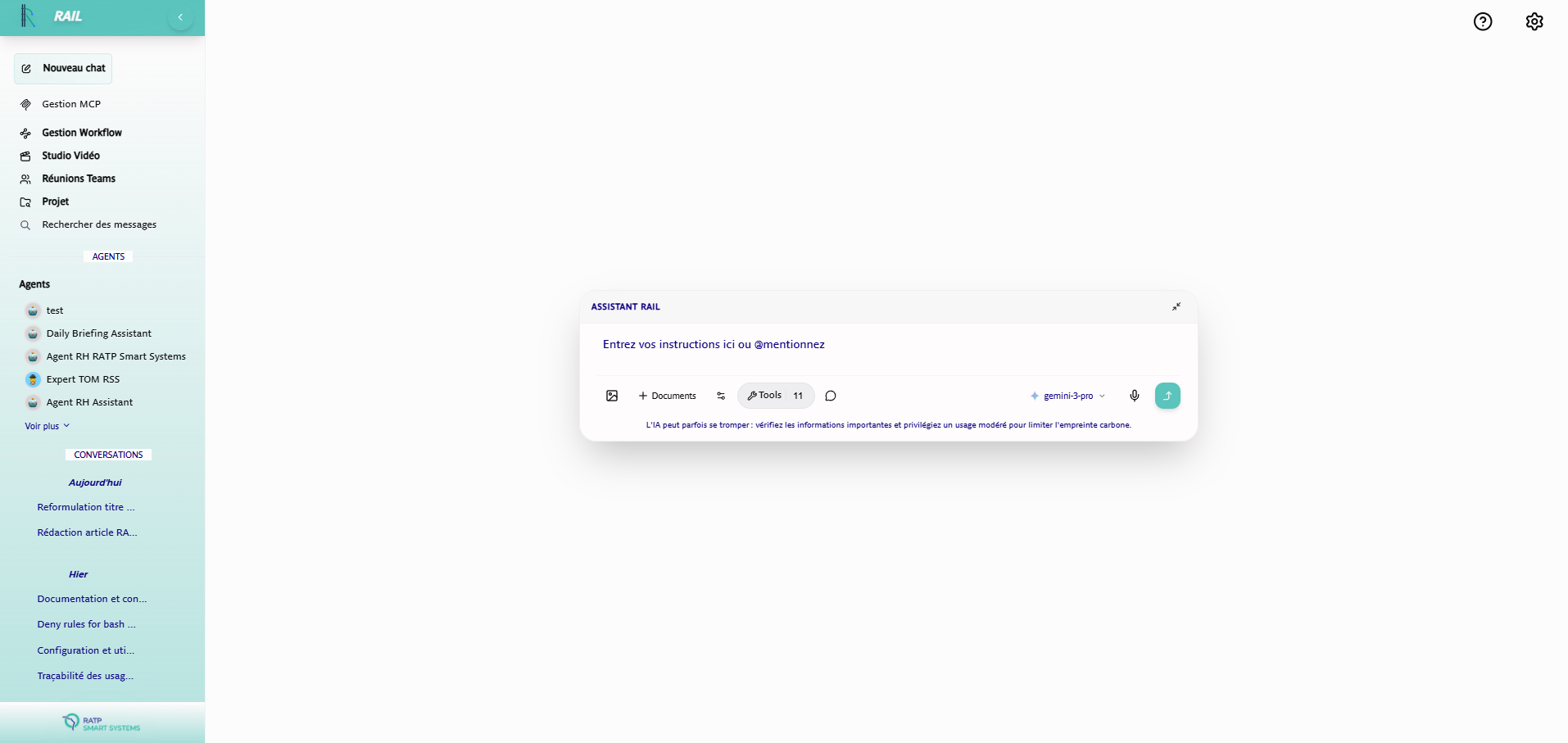
RAIL: A Generative AI Lab at the Heart of RSS
RAIL — standing for RATP Smart Systems AI Lab — is the internal platform for accessing generative AI tools at RSS. Spearheaded by the Datalab, the company's data and AI team, RAIL was designed as a true innovation laboratory accessible to all employees, regardless of their profile or profession.
A Multi-Model Architecture
One of RAIL's strengths lies in its multi-LLM approach. Rather than locking itself into a single provider, the platform grants access to several large language models, including:
| Provider | Available Models | Typical Use Cases |
|---|---|---|
| OpenAI | GPT-5 | Drafting, analysis, synthesis |
| Anthropic | Claude | Code analysis, long documents |
| Gemini | Drafting, analysis, synthesis | |
| Mistral AI | Mistral Models | Sovereignty, European use cases |
This multi-model strategy offers several advantages:
- Independence from a single provider.
- Adaptation to use cases: each model has its strengths.
- User awareness regarding performance and cost differences between models.
Features: Much More Than Just a Chatbot
Initially launched as a conversational interface, RAIL has evolved significantly to become a comprehensive platform. Here is an overview of its main features:
💬 Smart Multi-Model Chat
The chat interface allows users to ask questions, draft content, analyze documents, or debug code. The user can choose their model based on their needs.
🤖 Custom Agents
Similar to OpenAI's GPTs, RAIL allows for the creation of agents dedicated to specific tasks. These agents embed system instructions, business contexts, and tool libraries to facilitate adoption.
📄 Document Analysis
Employees can upload documents (PDFs, text files, logs, etc.) to get summaries, extract key information, or ask specific questions about the content.
🔌 Integration with Development Tools
RSS technical teams use RAIL in their workflows: coding assistance via extensions or CLI tools, and merge request analysis. Each employee has access to a RAIL API to utilize LLMs for projects or developments.
🔧 Tools – Digital Superpowers
RAIL is a true hub. It breaks down information silos by connecting to internal knowledge bases and the Web in real-time. It then takes action thanks to visualization tools (curves, diagrams) and office automation, enabling the creation of reports or presentations in seconds.
Some available tools:
- 🌐 Web Search: Real-time Internet access for up-to-date information.
- 🏢 Microsoft 365 Suite: Connection to Outlook (emails), Teams (messages), Calendar, and OneDrive/SharePoint.
- 💬 Slack Connectors.
- 📊 Data Visualization: Creation of charts (pie charts, bars, curves), interactive tables, and timelines.
- 🎨 Presentation Creation: Automatic generator for PowerPoint slides.
- 💻 Development & Quality: Connectors for GitLab (code) and Xray (tests/Jira).
- 📝 File Production: Generation of downloadable documents (Excel/CSV, code, text) and visual interfaces (similar to Anthropic's Claude Artifacts).
A Large-Scale Acculturation Initiative
Building the tool is not enough: employees must adopt it. RSS has implemented a comprehensive generative AI adoption plan to spread usage throughout the organization.
The Pillars of the Acculturation Strategy:
- Channels on discussion spaces.
- Internal events — RSS organized sessions to present what generative AI can bring and how the company has already embraced it, as well as practical workshops.
- Training and workshops — In 2026, employees will have access to an RSS Generative AI training course.
"The goal is to spread generative AI throughout the RSS organization to make it a success." — Generative AI Adoption Plan, RSS (January 2026)
Key Takeaways from the RAIL Project
RSS's journey with RAIL highlights several lessons applicable to any organization wishing to embark on this path:
- ✅ Security as a Foundation: The founding act is end-to-end security: both technical and contractual. Ensuring that model providers do not reuse data is essential.
- ✅ Multi-Model Strategy: Offering multiple LLMs avoids dependency, stimulates comparison, and allows the tool to be adapted to different business needs.
- ✅ Human-Centric Approach: Technology alone does not drive adoption. Workshops, communication channels, events, and sharing concrete use cases are as important as the tool itself.
- ✅ Continuous Iteration: RAIL evolves constantly, guided by user feedback. The latest version dates from February 25, 2026 — integrating new features for autonomous presentation generation and in-interface editing.
What’s Next?
RAIL's future is aligned with the RSS Data & AI 2026 roadmap, with clear ambitions: making employees autonomous, expanding the scope of AI agents to increasingly complex tasks, and exploring agentic AI — systems capable of executing end-to-end tasks autonomously.
At a time when generative AI is reshaping the contours of every profession, RATP Smart Systems proves that an intermediate-sized company, specializing in intelligent transport systems, can not only follow the trend but also innovate internally for its own teams.